
SCALE: Scientific Computing And Learning at Exascale
Machine learning (ML) is transforming computational science and engineering. Yet its foundations are increasingly strained at scale: training large models remains costly and largely empirical, learned surrogates often lack error control, and their integration into simulation and design pipelines is still largely ad hoc.
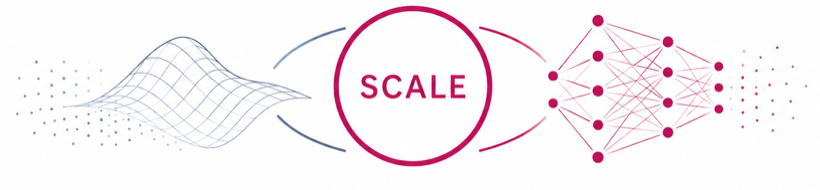
The SCALE group at UNIGE works at the interface of scientific computing and machine learning (ML). Our overarching goal is to develop the mathematical and algorithmic foundations for reliable, scalable computing-and-learning technologies for science and engineering at exascale.
We bring tools from optimization and numerical analysis — including globalized multilevel, domain-decomposition, and preconditioning methods — to ML, with the aim of developing efficient, parallel, and provably convergent algorithms for large-scale training. At the same time, we bring ML to scientific computing by developing ML-augmented numerical solvers and learned surrogates that combine the speed and flexibility of learning with the reliability and error control of numerical methods.
The SCALE group at UNIGE works at the interface of scientific computing and machine learning (ML). Our overarching goal is to develop the mathematical and algorithmic foundations for reliable, scalable computing-and-learning technologies for science and engineering at exascale.
We bring tools from optimization and numerical analysis — including globalized multilevel, domain-decomposition, and preconditioning methods — to ML, with the aim of developing efficient, parallel, and provably convergent algorithms for large-scale training. At the same time, we bring ML to scientific computing by developing ML-augmented numerical solvers and learned surrogates that combine the speed and flexibility of learning with the reliability and error control of numerical methods.
Descriptions of ongoing and past research projects can be found here.